
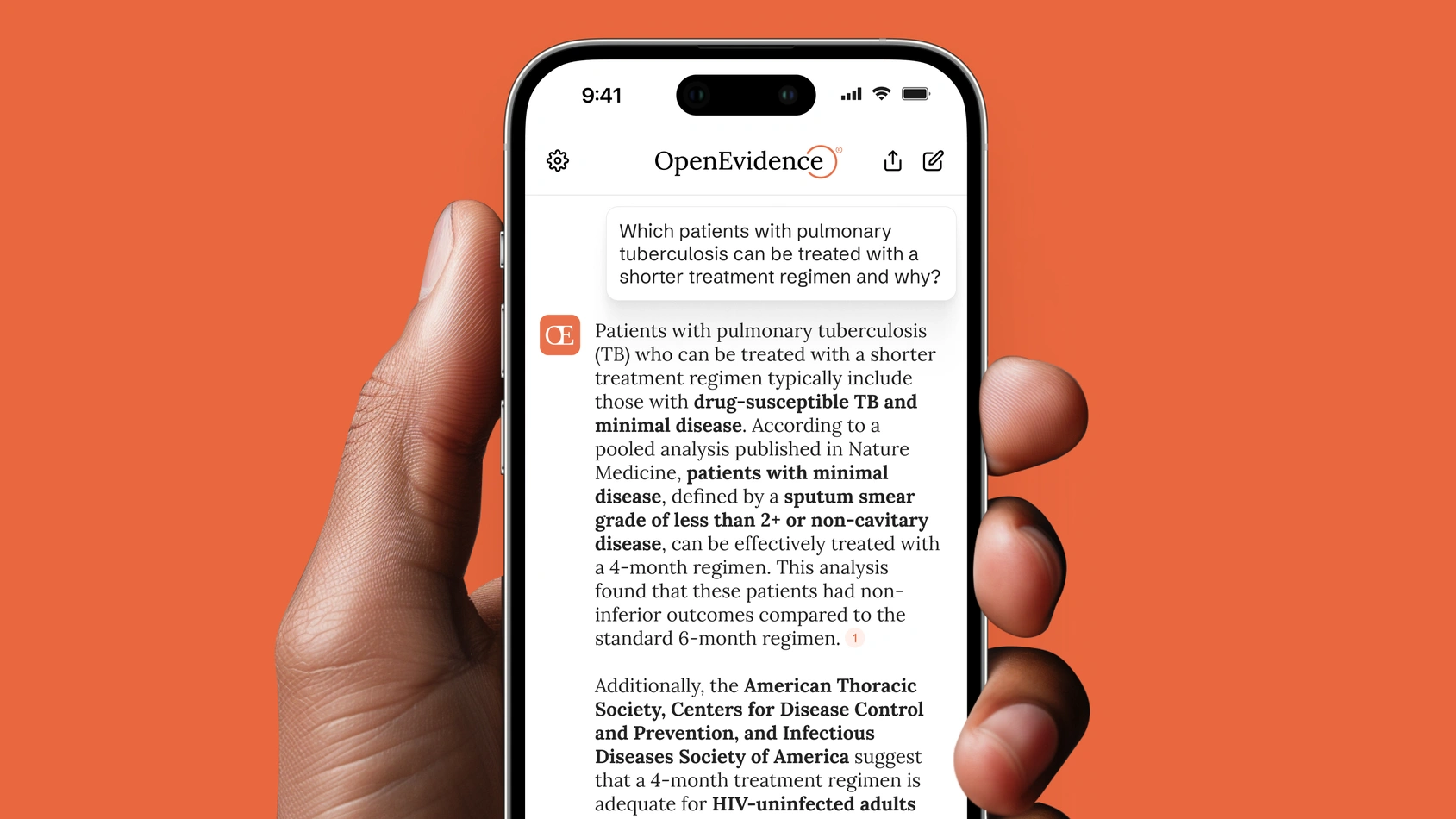
OpenEvidence's EHR push
Increasingly, OpenEvidence has found its market advantage threatened by competitors: recently, EHR vendor Epic and OpenAI’s ChatGPT announced updates with functions that mirror OpenEvidence’s core product, and Anthropic debuted Claude Science, a product which resembles OpenEvidence instead adapted for scientific laboratories. In response, OpenEvidence CTO Zachary Ziegler assured health providers that OpenEvidence is run by “totally reasonable, normal human beings in some ways,” and not by “crazy monsters.” Duly noted, Zachary.
Ziegler’s assurance of his own humanity – and to clarify, Zachary seems quite human to us – comes as part of OpenEvidence's effort to resolidify its market position by integrating into hospital EHRs. To expand its suite of services, OpenEvidence, which has landed agreements with Mount Sinai and Presbyterian in New York, Sutter Health in California, and Cedars-Sinai in LA, announced integration of EchoNext, an AI system reportedly capable of identifying structural heart disease from images of electrocardiograms.
AI analysis of ECGs is promising, and with deep learning, LLMs are even generating medical benchmarks previously unknown to researchers. In controlled research environments, EchoNext performs exceptionally, and the technology recently obtained FDA clearance. EchoNext, however, is yet to demonstrate clinical-utility within actual care settings. Its integration – especially as OpenEvidence attempts to embed itself into EHRs – demonstrates that ROI should emerge as a key governance pillar for AI leaders. That means that ROI evaluation is not simply savings analysis; rather, leaders ROI should interrogate the patient and provider experience and health outcomes delivered by each AI tool.
That type of interrogation will reveal a clear trend: clinical accuracy is not always indicative of clinical performance.
Remember Epic sepsis?
Consider Epic’s AI sepsis detection algorithm as a lesson from the (not-so-distant) past. Five years ago, hundreds of hospitals adopted Epic’s sepsis algorithm, which, even after impressive sandbox results, failed to perform in real-world clinical settings. It wasn’t a technical flop. Rather, Epic's detection threshold was too sensitive, and the algorithm sent so many alerts to doctors that many clinicians ignored them entirely. Despite its diagnostic accuracy – and Epic really did catch many cases of sepsis – its clinical utility was faulty.
EchoNext walks like Epic sepsis. Researchers trained the EchoNext model on over 700,000 echocardiograms conducted at Columbia and New York-Presbyterian. In FDA validation data, EchoNext detected 74% of patients who had structural heart disease. Columbia University – who hosted and funded EchoNext’s development – maintains that “when cardiologists use EchoNext, they are about twice as likely to identify structural heart disease” as compared to traditional care. Its rate of false positives problematizes that claim: in clinical trials, only 62% of patients flagged for structural heart disease carried the condition, good for one in every four disease-free patients.
Lead researcher Pierre Elias clarifies that the alert threshold was designed intentionally, such that “any clinician using this technology feels like, “if I order this test twice, one of those two patients is going to be positive.” That is, the alert threshold was adapted intentionally for the controlled study at Columbia and Presbyterian.
After failure, Epic made a similar claim: clinicians failed to properly “tune” the model. Five years onward, Epic’s new model, ESM v2, outperforms ESM v1 on all metrics of clinical accuracy. Still, its clinical utility is dubious: researchers claim health systems using ESM v2 would need to “manage or silence approximately 21 to 35 alerts to catch a single sepsis case” within 12 hours. If its clinical threshold is too low, EchoNext, like Epic, risks overwhelming providers with increased costs, increased anxiety for patients, and infrastructural burnout.
Jury's out for EchoNext
EchoNext’s alert threshold could perform well in clinical care settings. Or it couldn’t. We don’t know, because researchers have yet to validate the model's clinical utility, but the stress test is coming anyway: OpenEvidence is implementing EchoNext as it integrates into the native EHR networks and infrastructural dependencies of major hospital networks. Does EchoNext, then, quack like Epic sepsis? At Mount Sinai, Sutter Health, and Cedars-Sinai, only system failure will tell.
Clinical utility should be reported to providers not only through internal vendor auditing, and system failure shouldn’t be the architectural condition for exposing clinical futility. Evaluating ROI resilience is thus the emergent paradigm. The jury’s out: if, at Mount Sinai, Sutter Health, and Cedars-Sinai, EchoNext quacks, it will quack loudly.
References
[1] https://www.statnews.com/2026/05/20/openevidence-pitches-hospitals-we-are-not-monsters/
[2] https://www.statnews.com/2026/06/23/pathway-labs-echonext-ai-tool-heart-disease-detection/
[3] https://www.nature.com/articles/s41586-025-09227-0
[4] https://www.nature.com/articles/s41586-026-10674-6
[6] https://www.statnews.com/2021/07/26/epic-hospital-algorithms-sepsis-investigation/
[7] https://www.statnews.com/2026/05/12/ai-sepsis-detection-startups-challenge-epic-systems/
[8] https://www.columbiadoctors.org/news/can-ai-help-cardiologists-diagnose-structural-heart-disease


.png)