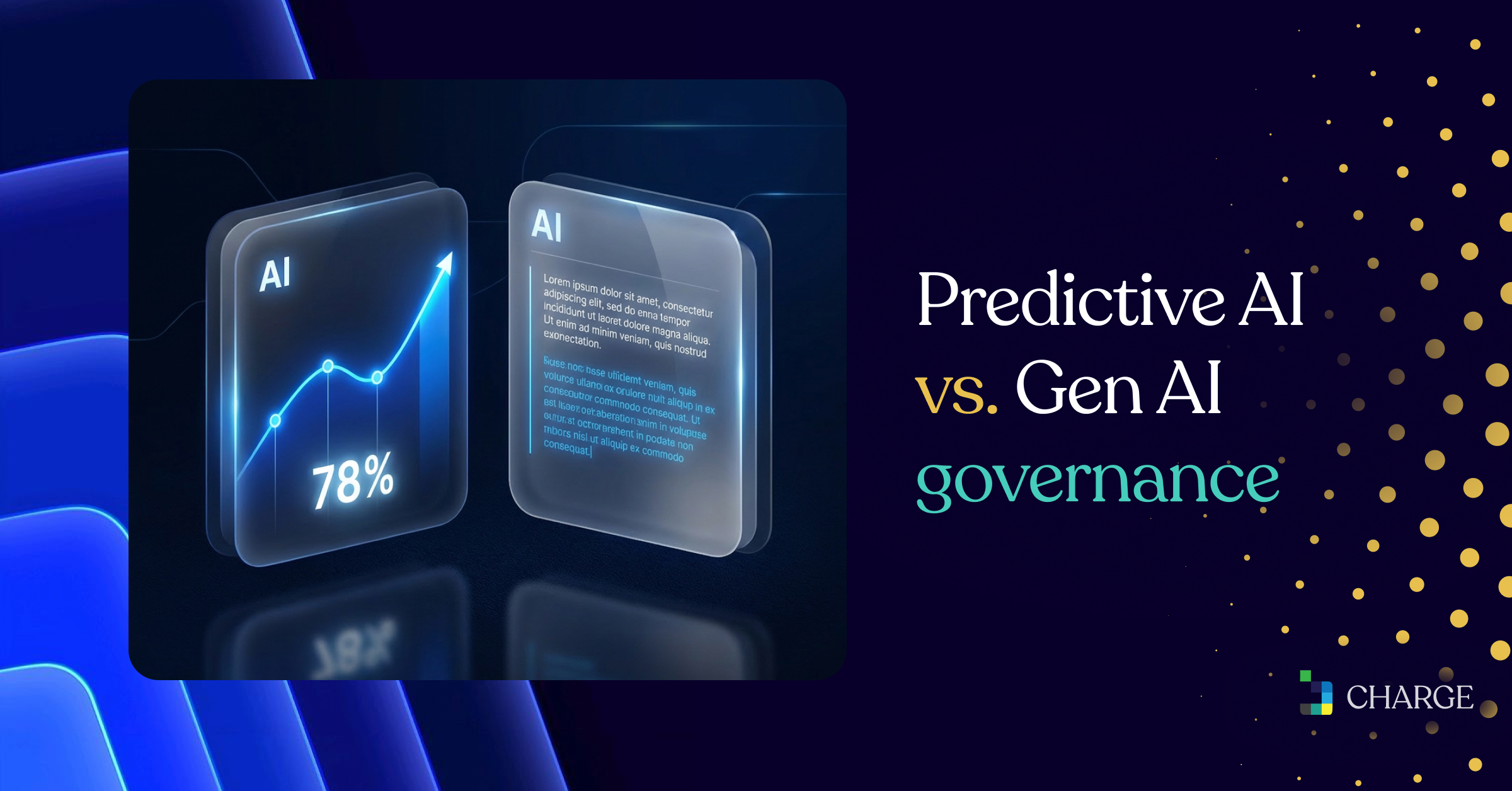
“AI governance” has become a standard phrase in healthcare. Yet the term increasingly covers technologies that differ in architecture, risk profile, and oversight requirements. A sepsis prediction model trained on labeled EHR data and an LLM drafting discharge instructions are both labeled “AI,” but their performance characteristics and failure modes diverge in important ways. Treating them as interchangeable under a single governance logic risks obscuring material differences.
Predictive AI
Predictive AI in healthcare has developed within a relatively stable technical and regulatory paradigm. Models are trained on structured inputs to generate defined outputs: risk scores, classifications, or alerts. They are optimized against labeled datasets drawn from identifiable patient populations. Evaluation is anchored in statistical performance — discrimination, calibration, and subgroup behavior — and deployment assumes that training and operational environments are reasonably aligned.
Generative AI
Generative AI, particularly large language models, operates under a different set of assumptions. These systems are not trained for a single clinical endpoint. They are general-purpose models adapted through prompting, retrieval layers, and workflow integration. In healthcare settings, they are used to summarize encounters, draft patient messages, translate instructions, assist with appeals, or support internal knowledge retrieval.
Outputs are narrative rather than numerical. The same underlying model may support multiple workflows simultaneously, often with limited transparency into its pretraining data or internal representations. Performance variability may stem from prompt design, context length constraints, retrieval configuration, or shifts in user interaction patterns.
These architectural differences translate into distinct monitoring requirements.
Difference 1: Clarity of Performance Metrics
Predictive models lend themselves to well-defined performance metrics. At their core, they function as classifiers or regressors. Monitoring can be structured around false positives, false negatives, true positives, true negatives, calibration curves, and area-under-the-curve metrics. Degradation becomes visible through changes in these parameters. Governance processes can therefore rely on statistical thresholds and predefined triggers for review or recalibration.
Generative systems do not produce outputs that map cleanly onto confusion matrices. A discharge summary may omit a clinically relevant detail; a patient message draft may introduce an unsupported recommendation; a translation may subtly alter meaning. The error space is qualitative and context-dependent. While structured review frameworks and automated screening tools can be implemented, the absence of binary endpoints complicates automated surveillance. Monitoring requires a broader interpretive layer that combines quantitative signals with expert evaluation.
Difference 2: Ground Truth and Evaluability
Predictive monitoring depends on a relatively clear triad: input data, model output, and ground truth labels. Performance can be evaluated against known outcomes. Even when labels are delayed, retrospective adjudication is possible. This architecture allows organizations to quantify accuracy and detect deterioration with a degree of objectivity.
In many generative healthcare use cases, ground truth is ambiguous or non-existent. There may be multiple acceptable ways to summarize an encounter or respond to a patient inquiry. Determining whether an output is “correct” often requires professional judgment rather than comparison to a canonical answer. Additionally, generative outputs are frequently edited by clinicians before finalization, introducing human–model interaction effects that complicate attribution of error. Monitoring must therefore incorporate process measures — such as edit rates, acceptance ratios, and escalation frequency — alongside structured content review. Governance shifts from measuring correctness against a fixed standard to assessing reliability, safety, and alignment with professional norms.
Difference 3: Dataset Shift and Contextual Instability
Predictive AI governance has long been organized around the concept of dataset shift. Models are trained on in-distribution data, and performance is expected to degrade when applied to populations or time periods that diverge from that distribution. Statistical drift detection — changes in feature distributions or outcome prevalence — serves as a central monitoring function.
Large language models do not fit neatly within this in-distribution versus out-of-distribution framing. They are trained on broad, heterogeneous corpora rather than narrowly defined clinical datasets. Variability in performance is more likely to arise from contextual factors: prompt formulation, retrieval pipelines, context length limits, evolving medical knowledge, or interface design. Instead of classical statistical drift, organizations must manage contextual instability and emergent behavior across workflows. Monitoring frameworks therefore need to address prompt robustness, reasoning stability, and consistency across specialties and patient subgroups.
Implications for Healthcare AI Governance Leaders
For AI governance leaders, these distinctions are operationally significant. A single oversight committee may remain appropriate, but its evaluation frameworks should differentiate between model types. Predictive AI governance should continue to emphasize validation rigor, subgroup equity analysis, and quantitative drift detection. Generative AI oversight requires structured sampling of outputs, monitoring of workflow-level behaviors, defined escalation pathways, and clear accountability for remediation.
As health systems expand their use of AI, precision in language becomes operationally consequential. Predictive and generative systems occupy distinct technical and risk domains. Effective governance will recognize those differences and design monitoring architectures accordingly, rather than relying on a single, undifferentiated framework.
Want to learn more?
Explore more of our research and insights on health AI safety.