The rapid advancement of AI is creating significant opportunities for healthcare organizations, while simultaneously raising important questions around governance and organizational readiness. Moving from experimentation pilots to sustainable enterprise adoption requires more than technological capability - it requires a strong data foundation, effective workflow integration, and a clear understanding of how AI can generate meaningful clinical value.
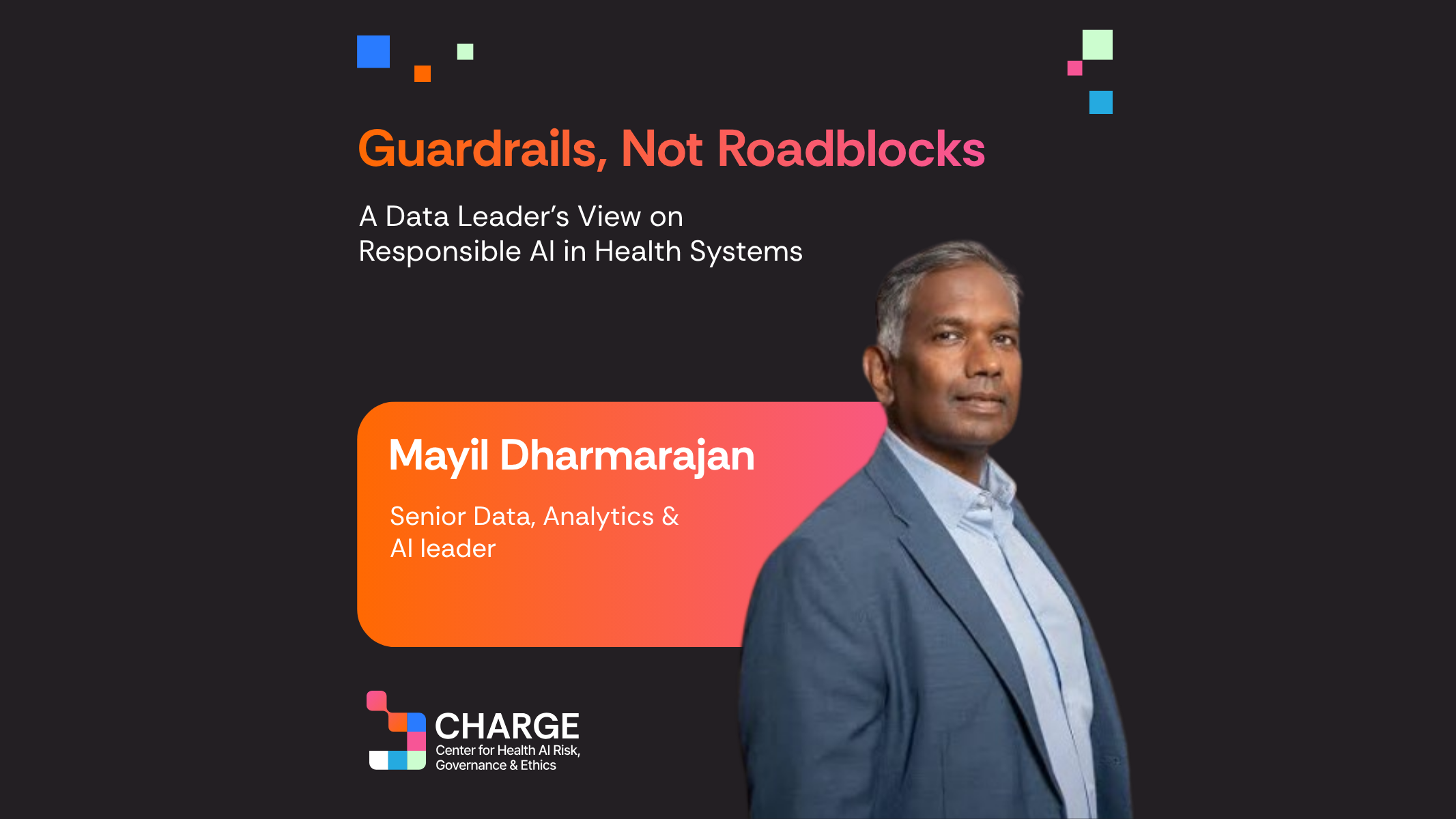
In this interview, CHARGE spoke with Mayil Dharmarajan, senior data, analytics & AI leader, about the evolving role of data and AI in healthcare. Drawing on decades of experience leading data, informatics, and AI initiatives across complex healthcare environments, Mayil discusses the practical and strategic considerations involved in responsible AI adoption.
Q: Could you briefly share your background and what initially drew you to the intersection of healthcare, data, and artificial intelligence?
Over the past two decades, I have led data, analytics, informatics, and AI initiatives across large integrated health systems and healthcare organizations. My work has spanned clinical care, research, hospital operations, enterprise transformation, and healthcare administration.
What continues to draw me to this field is the connection between information and impact. Inhealthcare, data is not simply a technology asset. Behind every data point is apatient, a family, a clinician, a researcher, or an operational decision that can ultimately affect someone’s care.
Working in an academic medical environment reinforced another important lesson. One of our key objectives was to better connect research, medical education, and clinical care so that innovation could reach patients more quickly and responsibly. That experience strengthened my belief that the true value of healthcare data lies not in collecting more of it, but in making it trusted, understandable, and available at the right point in the clinical, research, or operational journey.
I have also learned that technology alone does not create transformation. Throughout my career, I have focused on three interconnected elements: people, process, and technology, with the patient always at the center. That perspective also shaped my interest in responsible AI. AI has tremendous potential, but it will create lasting value only when we combine innovation with trust, governance, clinical judgment, and a clear understanding of the problem we are trying to solve.
Q: Throughout your career, you’ve emphasized the importanceof AI governance. How can health systems balance rapid AI adoption with the need for patient safety, privacy, and regulatory compliance?
I do not see governance and innovation as opposing forces. Effective governance accelerates innovation by providing clear pathways, defined ownership, and appropriate guardrails.
Health systems must first recognize that not all AI carries the same level of risk. An internal tool that helps employees search policies is different from an AI system that influences clinical prioritization, diagnosis, treatment, orpatient outreach. Governance should therefore be risk-based rather than applying the same review process to every use case.
I support the three-tier risk model. Low-risk administrative use case may qualify for an expedited review. Medium-risk operational applications require stronger validation, privacy review, and human oversight. High-riskclinical AI requires clinical leadership, patient-safety oversight, local validation, bias and equity assessment, explainability appropriate to the decision, and continuous monitoring after deployment.
Successful AI governance also requires visible executive sponsorship and shared accountability across clinical leadership, nursing, informatics, operations, privacy, cybersecurity, legal, compliance,research, and patient safety. Every AI solution should have a clearly identified business or clinical owner responsible for its performance, risks, and outcomes.
Finally, governance does not end at deployment. AI models must be continuously monitored for performance, drift, and changing clinical or operational conditions, with clear processes for revalidation, escalation, or retirement when necessary.
My philosophy is straightforward: Establish guardrails without creating unnecessary roadblocks. Protect the patient, caregivers, and the organization while giving responsible innovators a clear path forward.
Q: Many health systems have launched AI pilots, but few have successfully scaled them. From your perspective, what are the biggest barriers to enterprise-wide AI adoption, and how can organizations overcome them?
One of the biggest barriers to scaling AI in healthcare is that pilots are often treated as isolated technology experiments rather than as components of an enterprise strategy. A department may identifya vendor, complete a successful proof of concept, and expect the solution to scale, yet lack enterprise ownership, sustainable funding, work flow integration, workforce training, or ongoing performance monitoring. Without these foundations, even a successful pilot can struggle to move into production.
Another major challenge is the absence of atrusted data foundation. Many health systems still operate with fragmented data tal applications, research environments, and financial systems. AI cannot consistently deliver reliable results when data definitions, quality, lineage, access, and ownership are not well governed.
I experienced this first-hand during the integration of multiple hospitals, the opening of a new facility, and a majo reated as a stand alone initiative. It must advance alongside data integration, platform modernization, governance, and workforce readiness.
Workflow integration is equally important. Even technically strong models will not be adopted if they are difficult to understand, poorly integrated into clinical workflows, or fail to support better decisions. In one specialty-care initiative, AI summarized complex referral packages, but the real value came from designing the solution around what nurses needed, when they needed it, and how it could highlight actionable clinical and financial risks.
Another important lesson is that deployment is not the same as adoption. Sustainable adoption requires data and AIliteracy, role-based education, executive sponsorship, structured userfeedback, and close collaboration between AI teams and clinical and operational leaders.
Ultimately, scaling AI requires an enterprise operating model: disciplined intake, value-based prioritization, reusable technology platforms,risk-based governance, executive ownership, workflow redesign, training, continuous monitoring, and benefit realization. Organizations that build these capabilities will achieve enterprise-wide adoption; those that do not will continue to accumulate successful pilots without realizing sustainable value.
Q: As AI continues to mature, many healthcare organizations are deciding whether to build AI capabilities internally or partner with commercial vendors. What factors should guide that decision, and where do you believe health systems can create a meaningful competitive advantage by developing AI in-house?
I do not see build versus buy as a binary decision. Most health systems will need a hybrid model.
For mature,standardized capabilities, buying usually makes the most sense. Ambient documentation is a good example. Proven commercial solutions already exist, so organizations should focus on selecting the right partner, validating the solution locally, integrating it into the workflow, protecting patient information, measuring clinician adoption, and monitoring outcomes.
Building becomes more valuable when a solution reflects what makes the organization unique: its patient population, clinical expertise, research programs, data assets,operating model, or specialized workflows. Areas such as clinical trial matching, cohort discovery, precision medicine, complex referral intake,capacity management, and specialty care pathways often benefit from close collaboration among clinicians, researchers, informaticists, data scientists, and operational leaders.
The decision should be guided by a few key questions: Is the capability strategically differentiating or a commodity? Is there already a proven vendor solution? How sensitive is the data? How tightly must the solution integrate with local workflows? Does the organization have the expertise to build and support it? What is the total cost of ownership? Can it enable sustainable adoption without creating undue reliance on specific vendors? And who owns the intellectual property, derived data, prompts, outputs, and model improvements?
Internal capability does not mean building every foundation model. It means having the expertise to evaluate vendor claims, validate models on the organization’s own population, integrate them safely, negotiate appropriate data rights, monitor performance, and know when a solution is no longer delivering value.
My general principle is: buy where the market is mature, build where your organization is truly differentiated, and govern both with the same discipline.
Q: Beyond ambient clinical documentation, which generative AI applications do you believe will have the greatest clinical or operational impact over the next three to five years, and why?
Beyond ambient documentation, I see five areas with significant potential.
The first is clinical summarization and information synthesis. Clinicians are overwhelmed by referral packages, clinical notes, imaging reports, laboratory results, discharge summaries, and prior treatment records. Generative AI can organizeand synthesize this information, highlight what is most relevant, and support clinical decision-making. The emphasis, however, should remain on support. Clinicians must remain responsible for the final decision and be able to trace AI-generated summaries back to the original sources, while recognizing uncertainty and the potential for hallucinations.
The second is intelligent care coordination and patient navigation. Combined with predictive analytics, generative AI can identify patients who need follow-up, explain nextsteps in understandable language, support preventive-care outreach, and help patients navigate an increasingly complex healthcare system. Human oversightand equity monitoring remain essential.
The third area is research. Academic medical centers can use generative AI to support literature synthesis, cohort discovery, clinical trial feasibility, protocol development,chart review, and analysis of unstructured clinical information. Earlier in mycareer, I helped build a clinical research data warehouse that supported researchers and principal investigators in identifying IRB-approved patient cohorts. Generative AI can make capabilities like these more accessible, but research consent, privacy, provenance, and appropriate-use controls must be designed into the platform from the outset.
The fourth areais revenue cycle and administrative operations, where generative AI can streamline prior authorization, denial management, coding, documentation review, contract interpretation, and payer communications while preserving auditability and human accountability.
The fifth is an intelligent operational layer that enables leaders to ask natural-language questions about operations, quality, and financial performance and receive trusted, data-driven insights. The objective is not another chatbot, but decision support that explains what is happening, why it is happening, and what to do next.
Over time, we will also see more agentic AI capable of coordinating multiple tasks. In healthcare, however, the closer AI moves from assistance toward autonomy, the more critical human authorization, traceability, and patient safety become.
Q: Looking back, what are the most valuablelessons you learned about implementing AI within a large academic health system,and how have those experiences shaped your perspective on healthcare innovation?
The biggest lesson is that AI implementation is not primarily a technology project. It is an organizational transformation involving people, processes, workflows, data,culture, governance, and trust.
The second lessonis to begin with the problem, not with the model. It is very easy to become excited about new technology and then search for somewhere to use it. I have found it much more effective to sit with clinicians, nurses, researchers, and operational leaders and ask: What outcome are we trying to improve? What riskare we trying to reduce? Where are people making decisions without the right information? Where is there unnecessary friction? What is taking too long?
The third lessonis that trust must be earned. It is important to communicate openly, explain why the team is recommending a change, and understand where resistance iscoming from. People are more willing to participate in innovation when they understand the purpose, feel that their expertise is respected, and have a role in shaping the solution.
The fourth lesson is that health systems should not try to solve every aspect of governance at once. Identify what matters over the next three months, six months, and year. Put the necessary policies and processes in place, execute them well, learn from the experience, and then expand.
The fifth lessonis that academic health systems have an extraordinary opportunity, but also additional complexity. They bring together patient care, education, research, innovation, and large volumes of real-world data. They can translate discovery into clinical benefit, but they also have to navigate patient consent, IRB requirements, research access, privacy, intellectual property, and different expectations across academic and clinical environments.
These experiences have made me optimistic about healthcare AI, but also pragmatic. I believe we should move with urgency because the needs are real. At the same time, we should not mistake speed for progress. Sustainable innovation occurs when asolution is useful, trusted, adopted, measurable, and safe, not simply when it is technically impressive.
Q: From your perspective going forward, what do you see as the biggest barrier to widespread AI adoptionin healthcare,and what will it take to overcome it?
The biggest barrier is not the technology, it is organizational readiness and trust. Today, almost every health system is doing something with AI. But having pilots, vendor products, or a list of use cases does not necessarily mean an organization is ready to adopt AI broadly.
Trust is essential at every level. Clinicians need confidence that AI will support their work, patients need assurance that their data is protected, executives need evidence of measurable value, and governance teams need to know that risks are being appropriately managed.
Building that trust requires more than deploying AI tools. Health systems must invest in AI and data literacy, self-service analytics, multidisciplinary collaboration, and workforce training so employees understand AI’s strengths and limitations, as well as when human judgment must take priority.
Across the industry, I hear the same concerns repeatedly: responsible AI, governance, dataquality, interoperability, workforce readiness, and demonstrating return on investment. These issues are interconnected, and AI cannot scale on fragmented data or weak organizational foundations.
Equally importantis collaboration. Health systems benefit from sharing successes, failures, and lessons learned rather than solving the same problems independently.
Ultimately, AI adoption will succeed when it becomes a responsibly governed capability embedded in everyday clinical, research, and operational work. Success should be measured not by how many AI tools we deploy, but by the value they deliver, the burden they reduce, and the confidence they build.