AI is moving quickly into medicine, bringing new possibilities for clinical care while challenging long-standing assumptions about how medicine is practiced. As physicians begin to rely on AI for everything from clinical information and documentation to screening and decision support, questions of safety, accountability, and appropriate oversight are becoming increasingly important.
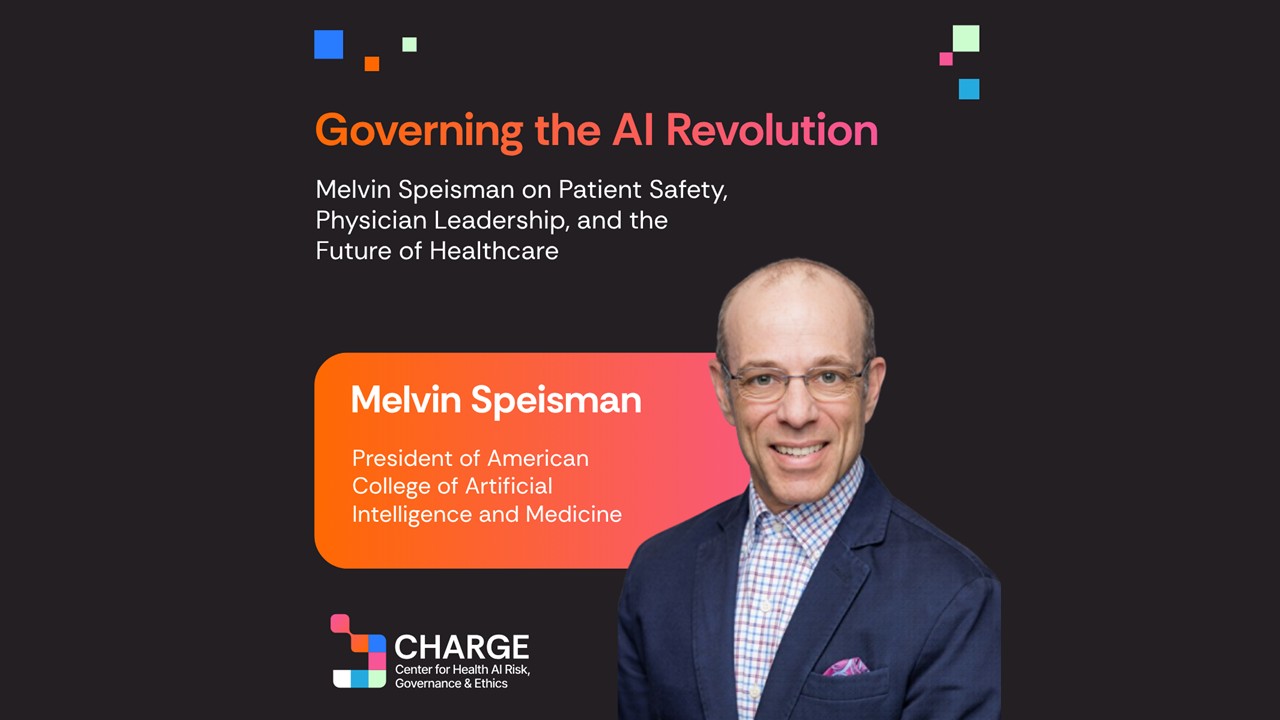
In this interview, CHARGE spoke with Melvin Speisman,President of the American College of Artificial Intelligence and Medicine,about the role physicians should play in shaping the future of AI in healthcare. Speisman discusses the need for greater physician education, the importance of responsible AI governance, the potential of AI to expand access to care, and the emerging questions around patient consent and accountability. At the heart of his perspective is a simple principle: AI in medicine must begin with first, do no harm.
Q: To start, could you tell us about your professional background and what led you to focus on AI and medicine?
My exposure to the growing role of AI in medicine came through many of the Grand Rounds and Dean’s invited lecture series at the University of Illinois College of Medicine, which focused on applications of AIacross medical subspecialties such as radiology, gastroenterology, and psychiatry. These sessions often had a reception afterward, where I had the opportunity to network with professors who were leading the way in applying AIto their respective fields. Seeing firsthand the breadth of these applications madeit clear to me that AI would be central to solving many of the difficult problems in medicine moving forward, and that to contribute meaningfully, I needed to dedicate all of my time to AI and medicine.
Q: You recently left your role at the University of Illinois Chicago to found the American College of Medical Artificial Intelligence and Medicine. What gap in the field led you to believe that physicians needed a dedicated professional home for AI?
At the University of Illinois Chicago College of Medicine, I began building collaborations between computer scientists, biomedical engineers, informatics physicians, radiologists, cardiologists, and health care leaders. Through these experiences, it became clear that to make a meaningful impact at scale, this same collaborative approach needed to extend to anational and international level through the creation of a nonprofit professional medical society. This vision ultimately led to the launch of whatis now the American College of Artificial Intelligence and Medicine.
Q: How has your experience as a clinician and internal medicine educator shaped the AMCAIM’s approach to AI education for medical students, residents, and practicing physicians?
As AI becomes increasingly integrated into clinical practice, medical education needs to evolve alongside it. In addition to beinga professional home for physicians interested in AI and medicine, the organization makes all educational and research activities free for medical students and resident physicians, and offers programs for college and high school students through our summer research internship program.
Q: How do you envision bedside teaching evolving as AI becomes part of the clinical encounter?
We currently have a monthly curriculum for resident physicians that is delivered live at five different teaching hospitals across Chicago. One of the most notable changes has been that many residents now use an AI tool such as OpenEvidence in real time to help inform decisions at the bedside.
Q: You have long advocated for ambient AI. Beyond reducing documentation burden, what evidence would convince you that these tools improve patient outcomes, and how should health systems measure their value?
When we speak at national or international conferences, we present randomized trials published in NEJM AI and JAMA on ambient listening. These studies demonstrate decreased cognitive load and reduced physician burnout. Some of the newer studies also show reduced time spent in the EHR and less after-hours documentation.
Hospital leadership should recognize that the ROI of these technologies is not simply about efficiency. It is also about retaining physicians who may otherwise leave the health system because of burnout. Thecost of recruiting a new physician can be significant, making physician retention an important part of the overall value of these technologies.
Q: When an AI -assisted error in healthcare harms apatient, how should responsibility be determined among the physician, healthcare organization, and AI developer?
While there is no single answer to this question, our organization’s approach is to address these issues through an annual panel discussion at our Chicago Scientific Session featuring leading professors oflaw who publish in this area. Last year, Barbara Evans from the University of Florida discussed these concerns, and this year, Sara Gerke from the University of Illinois will address them. Both have published papers in the NEJM providing guidance on these issues.
A central concern is whether and how AI use should be disclosed to the patient. For example, with an ambient listening system, an important question is whether the patient should provide consent before the system begins recording. The leading legal experts have argued both sides of this issue, including questions around when disclosure is necessary and how much information should be provided to the patient. These discussions are important because the appropriate documentation and disclosure practices are still evolving alongside the technology.
Q: How do you reconcile a global, equity-oriented mission with the real risk that AI amplifies existing disparities, and what is the AMCAIM doing to address bias and access in under-resourced settings?
One area that we are particularly passionate about is the use of AI to expand access to care in underserved and rural communities. There are examples of AI being deployed in rural areas in countries such as India and Thailand to provide care to patients who otherwise would not have access to it. One example I am referring to is a diabetic retinopathy screening tool developed by physician Lilly Pang at Google and deployed in these countries. Many years of follow-up on the success of this program over the past decade have been published in JAMA, demonstrating the potential for AI to extend access to care in communities that had limited access to medical services.
Q: The AMCAIM positions itself as a professional home for artificial intelligence in medicine, comparable in spirit to the American College of Physicians. What specific governance functions should a professional society perform that regulators such as the FDA, health system compliance offices, and vendors cannot or will not perform themselves?
We have a dedicated committee that meets regularly and is in the process of developing and issuing these guidelines to help guide the responsible use of AI in clinical practice. One of our current priorities is developing evidence-based guidance for the use of AI in medicine and across its various subspecialties. This will help physicians navigate the evolving role of AI in medicine.
Q: If you could offer physicians, health system leaders,and policymakers one guiding principle for the responsible governance of AI inmedicine, what would it be, and why?
Get involved with your hospital's AI governance program with a mission of "first, do no harm."