Q: Could you start by sharing a little about your professional journey and what inspired you to focus on healthcare data, AI, and digital transformation?
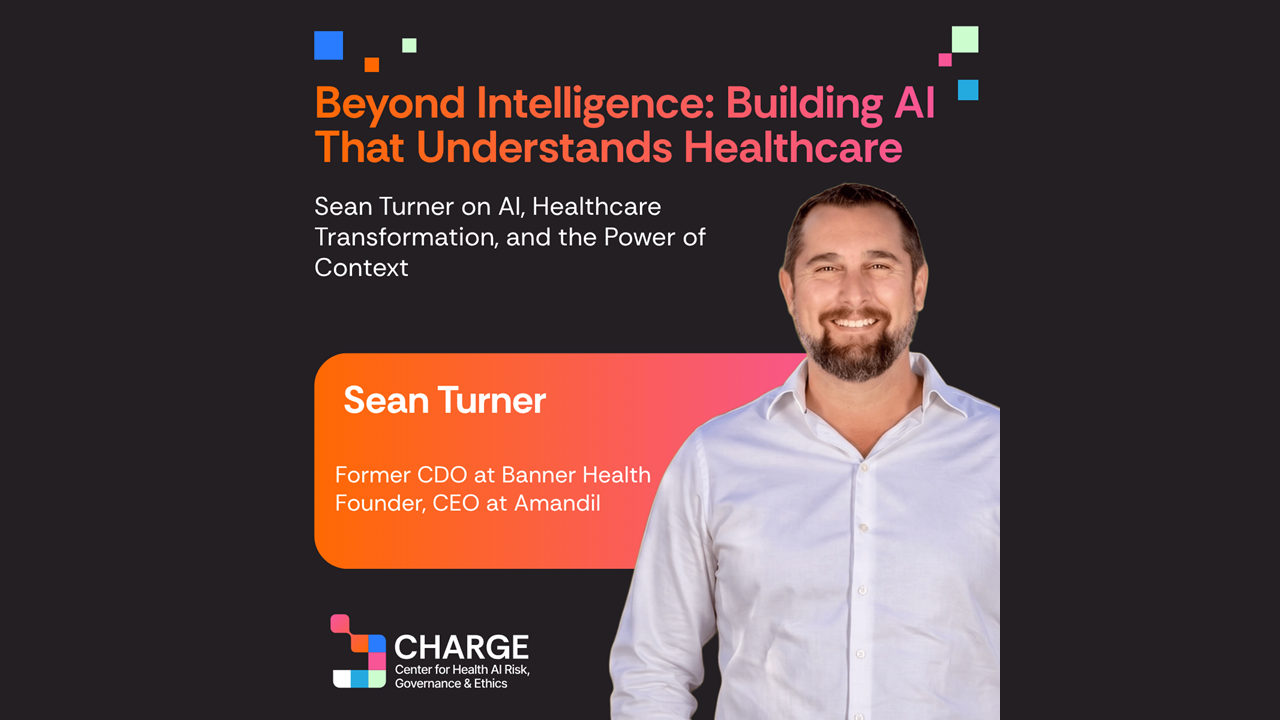
I’ve spent about 25 years in healthcare data and technology. I started in interoperability, application integration, healthcare standards, and population health, then expanded into enterprise data and analytics, digital, and ultimately AI. Today, I’d probably describe myself first as an AIleader, but that perspective is grounded in everything that came before it.
At CommonSpirit Health, as SVP of Data & Analytics, a major focus was post-merger integration: creating a common enterprise data platform and operating model across one of the country’s largest nonprofit health systems. I later joined Banner Health as Chief Data Officer to lead the broader data agenda. As generative AI emerged, my scope naturally expanded into AI governance, generative AI, and software development, including an enterprise generative AI assistant for the workforce.
I also represented Banner on the AWS Healthcare Strategic Advisory Council and worked with Anthropic’s Applied AI team as we began scaling AI. What shaped my thinking was seeing that the technology itself was rarely the hardest part. Healthcare’s complexity was. A capable model can still have very little understanding of how healthcare actually operates. That realization ultimately pushed me toward operational context and founding Amandil.
Q: As healthcare AI evolves from providing recommendations to taking increasingly autonomous actions, what organizational and clinical context must an AI system understand before it can operate reliably within a health system?
I think the amount of context required changes dramatically when AI moves from answering a question to taking an action autonomously.
If AI is summarizing information or helping someone reasonthrough a problem, a human is still interpreting the output. Once it starts initiating workflows, updating systems, communicating with stakeholders, or making decisions, the standard has to be much higher.
The AI has to understand the process it is participating in: what happened before, what should happen next, which systems are involved, what the dependencies and exceptions are, and where human approval or escalation isrequired. It also needs the surrounding operating context: relevant data, standards, regulatory requirements, and how that process connects to other parts of healthcare.
When those actions touch patient care, the stakes rise again. Clinical protocols, patient-specific circumstances, and the boundaries of clinical judgment become part of the context. That’s why I think agents are fundamentally a context problem as much as an intelligence problem.
Q: As AI becomes more capable and autonomous, governance has to evolve beyond simply evaluating individual AI models. What should effective AI governance look like in a health system today, and how should it evolve as organizations begin deploying AI agents?
A lot of early AI governance focused on the model: accuracy, bias, security, privacy. Those questions still matter, but health systems have to be careful about trying to become AI testing labs. The models are changing too quickly, and most organizations are not equipped to independently assure every underlying model at that level.
I think governance increasingly has to move to the application and workflow. What is the AI being used to do? What outcome do we expect? What are its boundaries? And when the model, prompt, context, or application changes, is the workflow still producing the results we expect?
That requires continuous evaluation and instrumentation: visibility into outputs, context, tool calls, actions, exceptions, and outcomes. With agents, you also have to govern authority: which systems they can access, which actions they can take, and when approval is required.
The operating model may start to look more like a security operations center than a traditional governance committee: instrument the environment, collect events, detect deviations, and respond. Governance becomes less about approving a model once and more about continuously assuring that AI-enabled workflows behave safely, reliably, and as intended.
Q: Healthcare is one of the most complex environments in which to deploy AI, with constantly changing regulations, clinical protocols, and organizational policies. How should AI systems account for this complexity without becoming too rigid or difficult to deploy?
I don’t think the answer is to encode everything an AI needs to know directly into every application or agent. That becomes brittle very quickly. I think you have to separate intelligence from context.
The foundation model provides reasoning capability. Then you give it access to structured context about the environment in which it is being asked to reason or act. We’re seeing the industry move in this direction with platforms such as Palantir Ontology, Databricks Genie Ontology, and AWSContext. I view that as strong validation that context is becoming a core part of AI architecture.
Healthcare adds another requirement: domain-specific operational context. There are thousands of interconnected processes, roles, dependencies, standards, regulations, systems, and workflows that are notunique to one organization. That is the layer we’re focused on with Amandil, designed to complement enterprise context platforms.
It also needs to be maintainable. If a regulation or standard changes, you should be able to update the underlying context rather than hunt through every prompt and agent that may depend on it.
Q: Some of today's AI infrastructure relies on retrieval-augmented generation (RAG), while Amandil takes a more structured approach to representing operational knowledge. Where do you see conventional RAG falling short in healthcare, and what does a structured context layer enable that retrieval alone cannot?
I think RAG is an important tool in the toolbox, and I don’t see structured context as a replacement for it. Retrieval is very useful for finding information relevant to a question or task. The limitation is thatfinding relevant information is not the same thing as understanding how work is supposed to happen.
That distinction matters more with agents. In some workflows, you don’t want a model deciding from scratch what the next best action might be. If a condition occurs, there may be a defined path: check a dependency, route to a particular step, or escalate an exception rather than improvise. You are putting some bounded behavior around a technology that is inherently probabilistic.
Structured context can represent those relationships, dependencies, constraints, and pathways explicitly. RAG can still retrieve the documentation or guidance needed within that flow. So I don’t think of it asRAG versus structured context. Retrieval helps AI find relevant information; structured context helps it understand how the work fits together and what should happen next.
Q: You have described "operational context" as a major missingpiece in enterprise AI. What does that mean in practice, and why is understanding how a healthcare organization actually operates so important for AI systems?
When I say operational context, I mean understanding healthcare as an operating system, not simply as a collection of data and documents.
Healthcare work is made up of thousands of interconnected processes involving different roles, systems, data, standards, regulatory requirements, and dependencies. That’s the context we’re structuring with Amandil: a machine-readable representation of healthcare operations that helps AI understand how a function fits into the broader environment around it.
Prior authorization is a good example. A model can easily tell you what prior authorization is. What’s more useful is understanding how it relates to eligibility, benefits, medical necessity, appeals, claims, industry standards, regulatory requirements, and the different stakeholders involved.
That is the difference I mean by operational context. It isnot simply giving AI more information. It is giving AI a structured understanding of how healthcare work fits together, which becomes increasingly important as AI begins participating in that work rather than just answering questions about it.
Q: From your experience working within large health systems, what separates an AI solution that looks impressive in a demonstration from one that can become part of everyday clinical or administrative work?
Workflow integration.
It is relatively easy to make AI look impressive in ademonstration. The harder problem is making it useful every day, at scale, inside the actual workflow of a health system.
Especially for providers, it almost has to feel like it isn’t there. Healthcare workers already have too many systems, screens, clicks, and interruptions. If AI adds another destination or another step, it can makethe work harder rather than easier.
The best AI will fit naturally into the workflow, have the right information and context at the right moment, and remove work rather than create more of it. Healthcare has solved versions of this problem before. SMART on FHIR helped applications integrate into clinical workflows; MCP is beginning to provide a similar connective layer for AI, linking models and agents to tools, data, and context.
Ultimately, the best AI won’t feel like another technology clinicians have to use. It will feel like a capable part of the team, embedded in the workflow and there when it’s needed.
Q: Given the enormous effort invested in advancing the intelligence of foundation models, do you believe the next major bottleneck is still model intelligence, or is it providing these models with sufficient understanding ofthe enterprise environments in which they operate?
I think the models are already more capable than most enterprises need for a large percentage of day-to-day work. We now have models solving extraordinarily difficult scientific and mathematical problems. Most healthcare workflows do not require that level of raw intelligence. They require AI that is reliable, predictable, and understands enough of the environment in which it is operating.
That doesn’t mean model development stops. The models will keep getting better. But another jump in benchmark performance does not necessarily solve the problems preventing broader deployment in healthcare.
A capable model still does not inherently understand how healthcare operations fit together: the processes and dependencies, the roles and systems involved, the standards and regulations, or the downstream implications of an action.
So the question increasingly is not simply whether the modelis smart enough. It is whether we can give that intelligence enough context and structure to put it to work reliably inside a complex operating environment.
Q: Looking two years ahead, what change in healthcare AI do you think is currently being underestimated, and what do you believe will determine which health systems successfully move from experimenting with AI to operating with it at scale?
I think people are underestimating how quickly AI will move from helping people do work to performing portions of the work itself, particularly where the work is repetitive, well understood, and measurable.
The bigger implication may be organizational. Leaders shouldbe asking where AI can take work away so people can spend more time on judgment, relationships, creativity, and expertise. The organizations that redesign work around that opportunity will have an advantage over those that simply add AI tools to existing processes.
But that requires technical agility. Health systems need aclear direction on public and private cloud, a modern data platform and data strategy, and enough internal understanding of models and AI architecture that they are not entirely dependent on what major technology vendors provide.
There is nothing wrong with consuming AI from an EHR or enterprise vendor; that is an efficient way to maintain parity. Sustainable differentiation will come from what an organization can uniquely do with its own data, knowledge, people, and operating capabilities. The winners will combine that foundation with strong governance and a will ingness to redesign how work gets done.