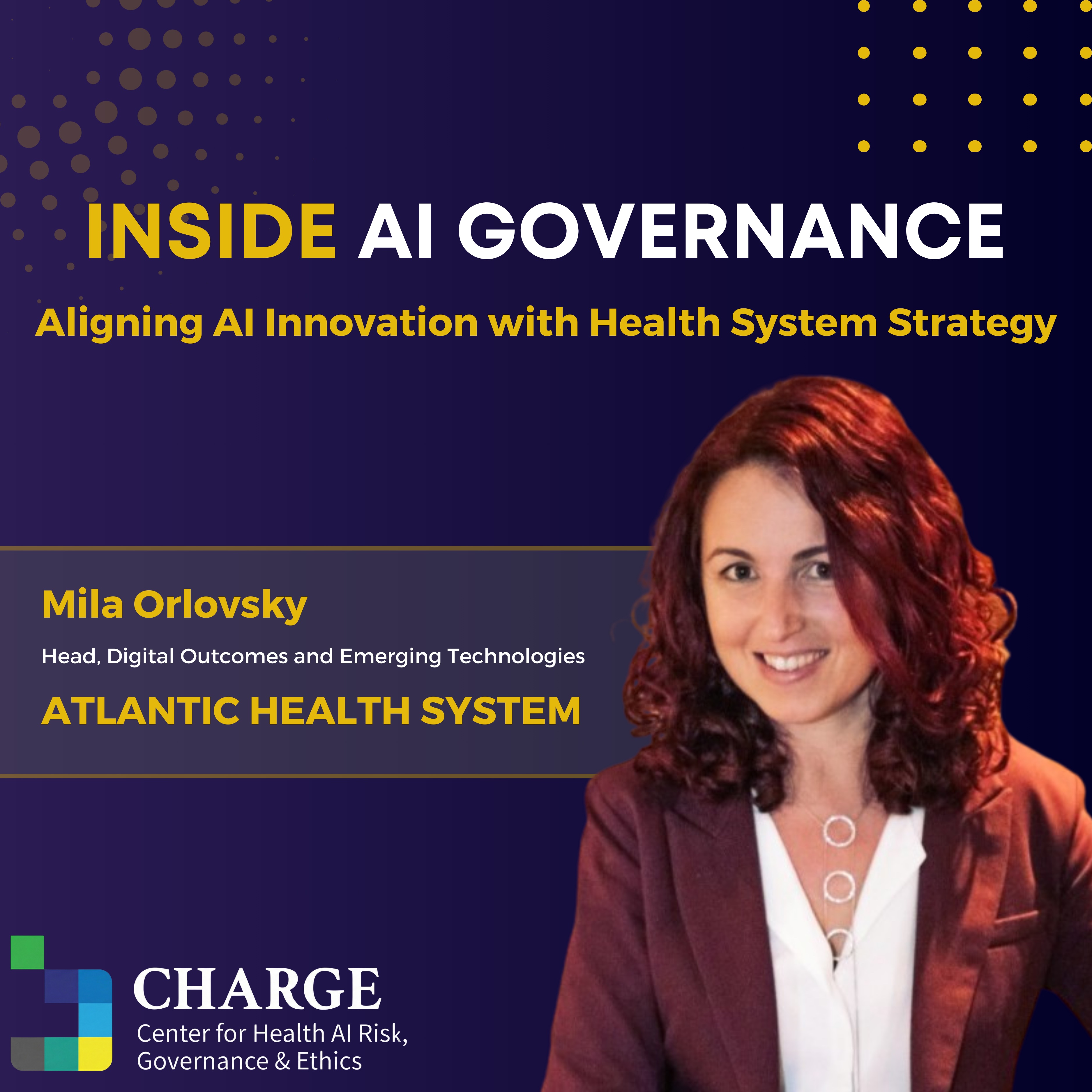
Mila Orlovsky is a healthcare data and AI leader with nearly 20 years of experience across clinical analytics, machine learning, digital health, and health system operations. Her career spans early EMR-based outcomes analytics at Tel Aviv Medical Center, AI product development in medical imaging at Zebra Medical Vision during the formative years of FDA-cleared clinical AI, and consumer-facing AI innovation as VP of Research at Antidote Health. She currently leads AI Governance at Atlantic Health System, where she develops frameworks for AI oversight, risk management, impact measurement, and responsible implementation across clinical and operational domains.
In this CHARGE interview, Mila shares a health system perspective on evaluating AI vendors, structuring internal AI intake, and aligning innovation with measurable value. She discusses governance design, transparency expectations, problem definition, and the evolving role of clinicians as AI becomes embedded across workflows.
Read the full conversation below.
Q: To start, could you share a bit about your professional path so far, and what drew you into healthcare AI?
I’ve been working at the intersection of healthcare and data for nearly 20 years. While completing my bachelor’s in Industrial Engineering & Management specializing in Information Systems at Ben-Gurion University, I joined a newly formed team at Tel Aviv Medical Center focused on extracting insights from EMR data to improve clinical outcomes. This was the first year EMR data was available, and the idea of using data at scale to inform care was novel. That experience sparked my interest in designing and developing technology and driving insights that improves care delivery.
Over the next decade, I led complex clinical and operational analytics initiatives, developing a deep understanding of healthcare workflows, systemic pain points, and how real-world clinical data behaves. As the field evolved toward advanced analytics and ML, I completed a master’s in Data Science and joined Zebra Medical Vision, one of the first companies to apply Deep Learning to medical imaging and receive first FDA clearance for AI products, at a time when regulatory pathways were still emerging. The company was later acquired by Nanox AI.
I then led Data Analytics and Data Science teams as VP of Research at Antidote Health, a digital-first HMO in the US, gaining experience in developing and analyzing consumer-facing and engagement-driven AI healthcare products. Now, at Atlantic Health, a leading New Jersey health system, I lead AI Governance by developing frameworks to measure impact, manage risk, and ensure responsible, scalable implementation. My journey across health providers and product vendors gives me a unique perspective on transforming healthcare through technology and data.
Q: You’re currently leading AI strategy and governance at Atlantic Health System. How do you describe your role, and what are your main responsibilities and focus areas today?
AI Governance are the frameworks and decision-making processes that guide how an organization responsibly adopts and uses AI technologies, ranging from publicly available LLMs to specialized clinical and diagnostic AI solutions.
My responsibility is to ensure that AI is implemented with the right policies, controls, and governance structures in place. Because the technology is evolving so rapidly, these frameworks are designed to be solution-agnostic and process-driven, with oversight that scales based on AI risk. This includes establishing appropriate governance committees, defining clear review and approval processes, building AI literacy across clinical and non-clinical users, and putting monitoring systems in place to assess how solutions are achieving their intended goals.
A key focus area is impact measurement. In clinical settings, determining whether an AI solution has improved a specific outcome is rarely straightforward. Outcomes are influenced by multiple factors, including provider behavior, patient engagement, and workflow adoption, all of which must be considered. On the non-clinical side, for everyday uses of Gen AI for meeting notes or email drafting, we focus on understanding productivity gains, roll out AI literacy programs to improve prompting practices, and ensure appropriate human oversight so teams are supported by AI rather than overly reliant on its outputs.
Another critical part of my role is reviewing new AI vendors and solutions for potential AI risks. This includes assessing compliance with organizational policies, evaluating risks such as accuracy, bias, and false alerts, and working closely with stakeholders and vendors to define mitigation strategies. In clinical environments, where AI outputs may influence decision-making, this risk assessment and mitigation work is especially important.
Overall, my focus centers on four areas: policies and guidelines, AI literacy, impact measurement, and oversight of new AI solutions, with governance committees and processes serving as the foundation that enables responsible, scalable adoption across the organization.
Q: A big part of your work involves AI vendor intake and evaluation. With the current flood of AI vendors approaching health systems, what are the biggest friction points in assessing and onboarding these solutions?
Indeed, a big part of my work is AI vendor intake and evaluation, and one of the biggest friction points is relevancy. Many vendors approach with solutions for problems we aren’t prioritizing or that we already have addressed.
Once a solution reaches assessment or potential contracting, another challenge is transparency. Vendors sometimes provide vague performance data or claim 100% accuracy, which is a red flag as typically no machine learning based algorithm achieves perfect accuracy. Such responses often indicate that the validation methodology was too narrow and the solution may underperform in practice. In some cases, vendors aren’t prepared to provide timely performance data or disclose validation methods, making it critical to have a monitoring plan in place from the start.
The final friction point is internal alignment. I work closely with operational and IT teams to ensure they understand that my goal isn’t to block initiatives, but to identify and mitigate risks before go-live. It’s much easier and safer to mitigate gaps in design or add contract terms ahead of implementation than deal with drifts in production, users mistrust or patient safety incidents.
Q: How are you addressing these vendor intake challenges day to day?
I work closely with vendor representatives and when needed, I ask to speak directly with their engineering teams to get the technical details that go beyond what sales or account managers may provide. My focus is identifying where risks may lie whether in performance, bias, explainability, or data handling and then engaging the relevant internal teams, such as IT, operations, or legal, to define appropriate mitigation strategies. This structured approach ensures risks are understood, addressed, and documented before a solution goes live.
Q: From your perspective as a health system leader, what advice would you give AI vendors who truly want to be strong partners, and make the process easier rather than harder?
My advice to AI vendors is to do their homework first. There’s a wealth of publicly available information: clinical quality benchmarks, academic research publications, conference appearances of our leadership, and organizational publicly available stats, that signal the real problems a health system might prioritize to solve and the solutions partners our system is already working with.
Trust is equally important. I value vendors who focus on solving a specific, well-defined pain point effectively, rather than promising to “reimagine” an entire area. Broad claims often signal that nothing is fully addressed. Honesty and modesty go a long way.
Finally, challenge the assumption that AI is always needed. Many problems can be solved with simple automation or even non-technologically. I recently heard a case study of a team improving operational efficiency simply by rearranging the nurse station. The strongest partners understand when AI adds true value and when it doesn’t and are willing to step down when it’s clear that AI is not the right solution for a problem.
Q: That’s the external vendor intake - but let’s talk about what I’d call “internal intake". Many health systems talk about “bringing AI to solve problems,” but that requires clarity on which problems are real priorities, which are worth solving with AI, and which simply aren’t. How do you think about, and actually execute, internal intake at your organization?
I come from a family of engineers, and Einstein famous quote was always in the air in our family: “If I had an hour to solve a problem, I’d spend 55 minutes thinking about the problem and 5 minutes thinking about solutions.” That idea is central to my approach. Defining the problem clearly is often the hardest part. Teams may feel a real pain point, but it’s not always clear how that issue appears at the scale of an entire health system, or whether it truly requires an AI solution.
To address this, we established structured internal workgroups with a rigorous intake process. Teams are asked to explain why the problem matters, curate baseline data that supports the claim, and set a target to how their proposed solution would move the needle. This encourages deeper thinking and often reframes the original request into a more precise, actionable problem.
For example, when considering early detection for a high-prevalence condition, we first analyze our own data: prevalence, cost of care, and outcomes. We then benchmark against peer systems and published literature to assess the opportunity for improvement before deciding whether AI is the right tool to deploy.
Q: On a related note, how do you handle demand that comes bottom-up from frontline teams versus top-down strategic priorities, especially when they don’t always align?
Both bottom-up and top-down inputs matter, but they serve different purposes. Frontline teams surface real operational pain points, while top-down leadership priorities ensure strategy and resources alignment.
When they don’t align, we apply a consistent evaluation framework that looks at impact, feasibility, and strategic fit. Bottom-up ideas that demonstrate measurable value can move forward, even if they weren’t originally on the roadmap. At the same time, top-down initiatives are shaped by frontline input to ensure they are practical and adoptable.
The goal is not to choose one over the other, but to use structure to balance insight with direction and prioritize what will deliver the greatest value.
Q: Zooming out: where do you see health systems AI strategy and oversight heading over the next 2-3 years?
I see health systems AI Governance evolving along two main trajectories.
First, there will be a strong shift toward value and impact measurement. The past several years were characterized by rapid experimentation and adoption, with many organizations focused on exploring AI capabilities and positioning themselves at the technological frontier. The next phase will require clear evidence of value. AI initiatives will increasingly need defined outcome KPIs from the outset, along with structured monitoring frameworks that track clinical, operational, and financial impact over time. Governance functions will play a central role in ensuring that AI initiatives remain aligned with strategic priorities and deliver measurable results.
Second, we will see a fundamental shift in human–AI interaction within clinical workflows. AI will increasingly function as an augmentation layer embedded across care delivery and operational processes. Clinicians will encounter AI-generated insights throughout the workflow: triage, data collection, diagnostic support, documentation, and follow-up. At the same time, patients will arrive more informed, often having already interacted with AI tools available on their personal devices.
In this environment, clinicians evolve from being the ultimate decision makers to becoming orchestrators of intelligence, combining clinical judgment, patient context, and AI outputs. Health systems that invest in governance, workforce training and rigor workflow design to support this interaction will be best positioned to witness AI’s value while preserving accountability.
Want to learn more?
Explore more of our research and insights on health AI safety.