Personal Competition, Multiplied Risk
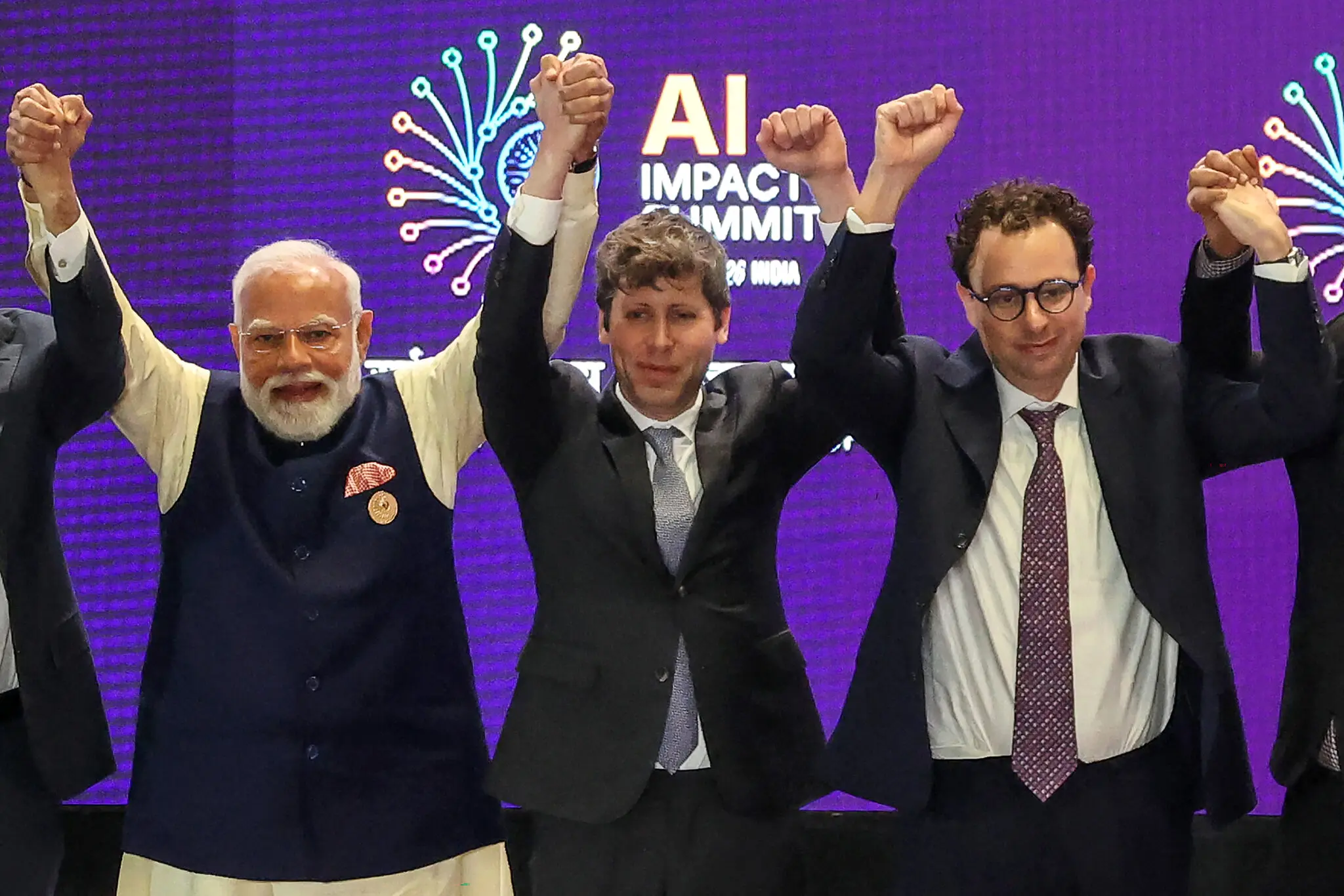
In late March, Anthropic CEO Dario Amodei castigated OpenAI for its so-called “mendacious nature” after it outbid Anthropic for a licensing contract with the Pentagon. The month prior, Amodei and OpenAI CEO Sam Altman couldn’t even shake hands at an AI “solidarity” summit in India – fittingly rendering the entire exercise moot.
Now, the two tech giants are pushing into healthcare at breakneck pace, and the rivalry is spilling over with them. In late June, ChatGPT announced its launch of ChatGPT Health for consumer health consultations. A week later, Anthropic parried with Claude Science, designed for drug discovery and computational biology. Amidst a massive hiring push, the two companies are competing for the same prize: enterprise licensing and trust.
For good reason: enterprise integration is coming for both OpenAI and Anthropic. As providers and tech leaders seek to simplify their sprawling tech stacks and retire redundant point solutions, they are turning increasingly to agentic AI vendors. But integrating agentic platforms exposes enterprises to agent hallucination and error replication. The new risk surface isn’t isolated failures. Rather, as OpenAI and Anthropic seek EHR and infrastructure integration, and try to displace point solutions altogether, individual failures transform from tolerable one-off artifacts to the error infrastructure of an entire health network. OpenAI and Anthropic are only the (flashy) tip of the iceberg – providers must know that for agentic AI, error is baked in.
Simultaneously, accelerated integration risks flaming the “deeply personal” feud between the two tech giants which has always left enterprises in the dust. Health networks should be wary. We cannot, and should not, tolerate vendor mendacity: like the Supreme Court, even the appearance of ethical impropriety should be intolerable. In healthcare trust between providers, vendors, clinicians, and patients isn’t optional. Proper governance will always begin and end with trust. That’s a governance demand, not a luxury.
The Push for Agentic Models
As Becker’s reported last week, CIOs nationwide are reconsidering their health stacks. That builds on CHARGE’s earlier market research, which covered OpenAI and Anthropic’s initial biosecurity job postings. Since CHARGE’s focus on early job postings at OpenAI, both companies have spotlighted a myriad professional opportunities in biological and chemical risk mitigation, life sciences, and health AI.
Across health systems and administrative geographies, IT leaders are pushing to consolidate platforms and shed point solutions. Large models promise health networks more efficient oversight and rationalized workflows, especially as new research questions the comparative advantage of domain-limited clinical AI tools.
Naturally, OpenAI and Anthropic have emerged as major competitors for health networks trying to rationalize their health stack. The table below compares the integration strategy of the two companies:
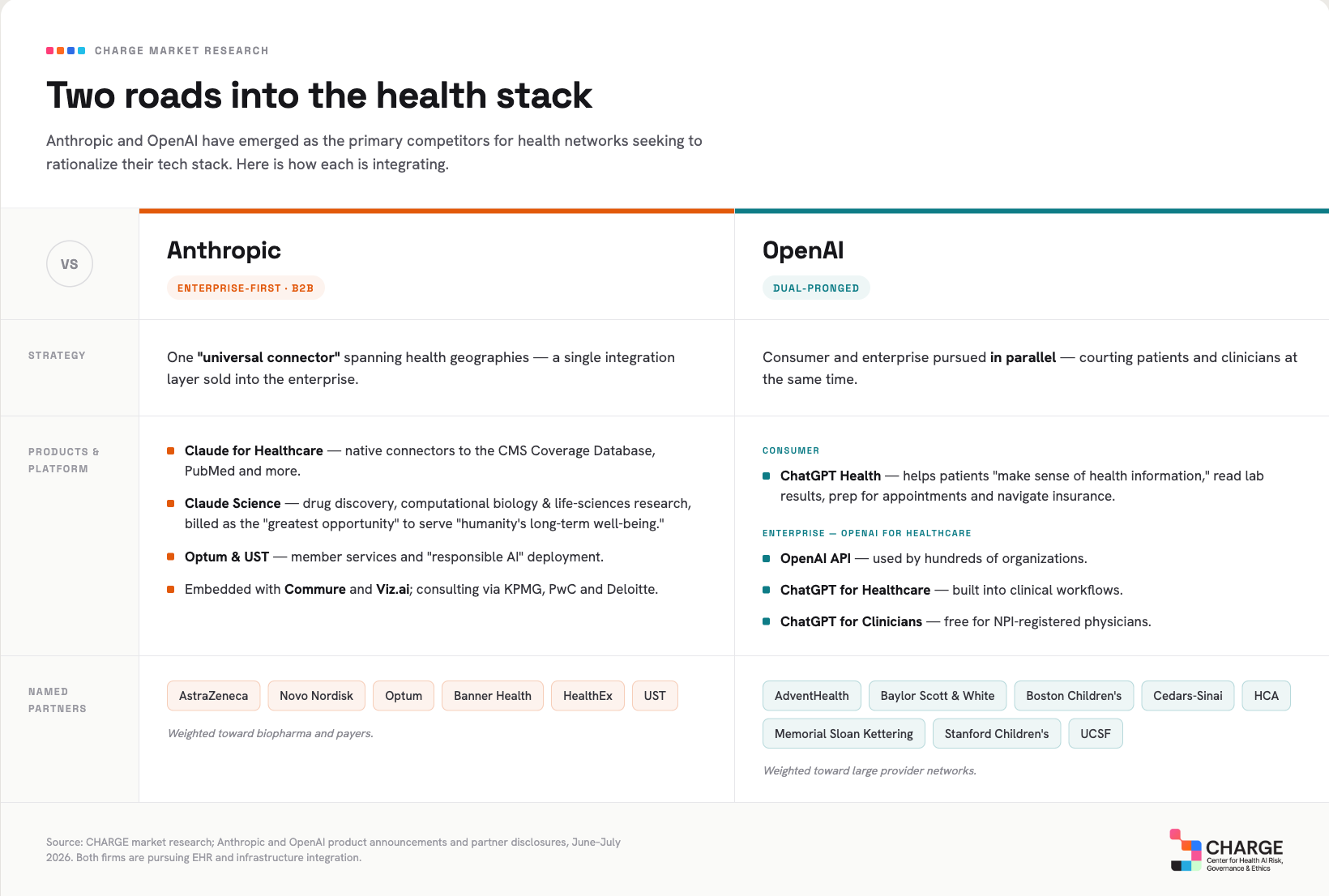
While Anthropic is pursuing a business-focused, enterprise-first strategy, OpenAI is aggressively courting both clinicians and consumers. The strategies uncover enterprise priorities, but the goal for both is to get inside health systems and crowd-out point solutions. That integration strategy rides the rationalizing wave, but also reveals something worth following: for providers, “rationalization” means agentic AI implementation. That both OpenAI and Anthropic have been so aggressive in their healthcare expansion – Sam Altman has even visited CMIOs at their hospitals – indicates that the desire for agentic AI is real and lucrative.
New Technology, New Risk Surfaces
The push for IT rationalization is necessary and, in many respects, overdue. But concentrating a handful of vendors under an entire health stack creates new and equally serious risk.
Claude AI is known, for example, to impersonate licensed physicians (even going as far to generate a fake Pennsylvania license and name itself “Dr. Claude Sage”) and diagnose skin cancer from inputted images. Similarly, while OpenAI’s ChatGPT for Health is purportedly bound to a strict data control constitution and tailored with HIPAA-compliant instructions, jailbreakers have easily bypassed content controls to generate concerning, violent, or sexually explicit content. A lawsuit filed against OpenAI and CEO Sam Altman on July 22 claims that ChatGPT recommended a pastor not seek necessary care before suffering a pulmonary embolism, because “God did not design your body to endlessly fail.” On the heels of that lawsuit, ChatGPT launched ChatGPT Health, now available for all U.S. users. OpenAI’s optical impunity underscores the tenacious pace at which it's targeting the healthcare network – and countering Anthropic. In the context of corporate hubris, new risks emerge every week: the concern is no longer only what agentic AI will recommend to patients, but also what it won’t.
Certainly, the risk isn’t contained to OpenAI or Anthropic products. Red-teamers, for example, manipulated Doctronic, a drug refill agent, into prescribing a cocktail of methamphetamine and triple dosage Oxycontin. Nor is the fear only about agent manipulation – agentic models are especially prone to hallucination. This week’s CHARGE Signal covers hallusquatting, a new malware strategy which can indirectly infect any agentic model at scale. Similarly, because a model is confident in its answers by design, it cannot flag its own hallucination – a textbook blackbox. The error mode is obscured, slips by auditing, and reveals itself, as CHARGE has spotlighted time and time again, only through failure.
The danger is not isolated nor extraordinary. It’s infrastructural. When agentic AI is woven into health infrastructure, the risk multiplies. Weeks ago, CHARGE coined the term ‘recursive AI’ and flagged Abridge’s partnership with NVIDIA to build AI models as a textbook example. Together with NVIDIA, Abridge wants to train a domain-limited AI model on top of its trove of recorded clinical conversations. Abridge’s transcription services, however, sometimes err – a tolerable bug in isolation. When an LLM is trained on top of error artifacts, however, those artifacts are transformed into the infrastructure of a new AI. Recursively, AI error builds on top of AI error, transforming error modes into risk surfaces. The same is true of hallucination.
"The same base models now sit under the ambient scribe writing your notes and the symptom checker on your portal, and unless someone is watching for it they inherit the same hallucinations and the same risk as the consumer-facing chatbots" - Yechiel Engelhard, MD, MBA, MHA
The integrated API and the model weights are identical, but the service is different. Now integrated into health infrastructure, vulnerabilities survive as health data rather than failure artifacts. And because agents cannot report their own errors, failure modes emerge only through disaster, with human lives on the line.
When OpenAI and Anthropic compete, they typify the risk
Neither Anthropic nor OpenAI are the only agentic AI organizations chasing enterprise-level integration, nor are they the only two with a documented history of risk. To safely AI models prone to manipulation and risk, governance leaders will need to build an iterative, collaborative framework for AI implementation and monitoring.
When mega-companies feud, however, providers are stuck between a rock and a hard place. By the end of 2025, OpenAI, Anthropic, and Google together controlled around 90% of the $37B enterprise AI market. That concentration already makes it hard for enterprises to manage the AI oligopoly, since limited alternatives means limited redundancy – switching providers becomes technically and commercially expensive.
More troublingly, when OpenAI and Anthropic compete, enterprises are hurt directly, not just hypothetically: both have cut off API for enterprises which shop with the other – Brookings characterized it as “a wake-up call” that OpenAI and Anthropic can “just cut off access to the AI model” an organization might “need to have a viable AI application.” If health networks were to lock in with one provider, they may be stuck forever.
That typifies the risk: personal rivalry between two dominant vendors, sitting on top of concentrated risk, doesn't stay contained in the boardroom or within hurled insults. Rather, rivalry structures instability, multiplies patient risk and network redundancy, and conditions organizational dependency. Healthcare providers should demand transparency and accountability. Whether OpenAI and Anthropic will provide it remains to be seen.
References
On OpenAI and Anthropic’s rivalry:
[1] https://www.nytimes.com/2026/03/07/technology/openai-anthropic-pentagon-rivalry.html
Their healthcare push:
[5] https://openai.com/index/openai-for-healthcare/
[6] https://openai.com/index/improving-health-intelligence-in-chatgpt/
[7] https://www.cnbc.com/2026/06/30/anthropic-launches-ai-drug-discovery-program-claude-science.html
[9] https://www.fiercehealthcare.com/health-tech/tech-services-company-ust-integrates-anthropic-claude
Their hiring efforts:
Health CIOs’ rationalization push, and hallucination concerns:
Jailbreaking and prompt injection:
[18] https://secondopinion.media/p/researcher-tricks-claude-into-tapering-medication
[19] https://mindgard.ai/blog/claude-offers-up-instructions-to-make-explosives
[20] https://www.bbc.com/news/articles/c802ldjdklzo
Frontier research:
[22] https://www.nature.com/articles/s41591-026-04431-5